Selected Ongoing Projects
“Endorsing Takeover: Elite Support for Regime Personalization,” with Kevin Koehler, Revise & Resubmit (2nd round) at American Political Science Review.
Abstract: Why do some regime elites endorse incumbents’ moves to dismantle executive constraints, even at the risk of their own marginalization? We develop a theory of elite endorsement of incumbent takeovers, arguing that endorsement depends on elites’ positions in the regime hierarchy. Central elites, who benefit most from existing power-sharing arrangements, risk losing influence if the leader personalizes power. Peripheral elites, in contrast, are less invested in the status quo and stand to gain from the disruption of established hierarchies, giving them stronger incentives to endorse personalization. We test this theory using an original corpus of parliamentary speeches by Turkish ruling-party legislators and derive individual-level endorsement estimates using instruction-tuned large language models. We show that peripheral elites are more likely to endorse personalization, and that more forceful endorsement increases the likelihood of post-takeover retention and promotion. These findings have important implications for understanding democratic breakdown and regime personalization.
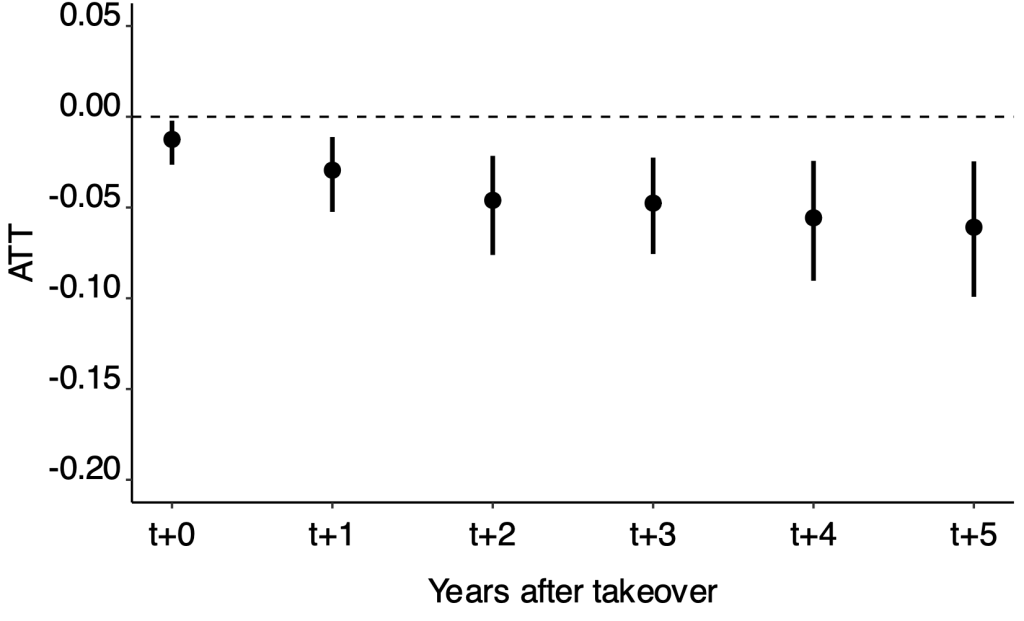
“Do Incumbent Takeovers Undermine Economic Growth?” Working Paper.
Abstract: Incumbent takeovers—episodes in which sitting executives dismantle institutional constraints and concentrate power—are an increasingly common form of regime change, yet their economic consequences remain poorly understood. Using a global panel of takeover events from 1900 to 2023 and a matching-based estimator for panel data, this article assesses whether executive power grabs undermine economic development. The results show sustained economic losses: within five years, GDP per capita is approximately 4–6 percent below its counterfactual trajectory. The evidence points to two political mechanisms. Takeovers weaken the rule of law, bureaucratic impartiality, and meritocratic recruitment, while increasing group-based inequalities in access to public employment, services, and business opportunities. Consistent with these institutional changes, both domestic and foreign investment decline, and total factor productivity deteriorates. Executive power concentration therefore imposes substantial and lasting developmental costs.
Published Articles
“Social Polarization and Electoral Incentives for Islamist De-Moderation: Evidence from Turkish Parliamentary Debates,” with Kevin Koehler, Democratization, first view, 2026.
“The Power of Cabinet Appointments: Elite Co-optation and Anti-Regime Mass Uprisings in Autocracies,” Journal of Conflict Resolution, first view, 2024.
“Opposition Party Organizations, Ideological Orientations, and Elite Co-optation in Electoral Autocracies,” Democratization, vol. 29, issue 4, 2022.
“Autocratic Ruling Parties During Regime Transitions: Investigating the Democratizing Effect of Strong Ruling Parties,” Party Politics, vol. 28, issue 2, 2022.
“A Global Perspective on Party Organizations: Validating the Varieties of Party Identity and Organization Dataset (V-Party),” with Nils Düpont, Anna Lührmann, and Ora John Reuter, Electoral Studies, vol. 75, 2022.
Datasets
“Varieties of Party Identity and Organization (V-Party) Dataset V2,” with Staffan I. Lindberg, Nils Düpont, Masaaki Higashijima, et al., 2022.
“Varieties of Party Identity and Organization (V-Party) Dataset,” with Anna Lührmann, Nils Düpont, Masaaki Higashijima, et al., 2020.

